

TL;DR – Quick Answer
The internet wasn’t invented in a single moment but evolved over decades. The foundation was laid on October 29, 1969, when ARPANET sent its first message between two computers. The modern internet as we know it took shape in 1983 when TCP/IP protocols were adopted, and the World Wide Web—what most people think of as “the internet”—was invented by Tim Berners-Lee in 1989. So depending on how you define it, the internet is either 56 years old (ARPANET), 42 years old (TCP/IP), or 36 years old (World Wide Web).
The Birth of the Internet: It’s Complicated
Here’s the thing about the internet’s birthday—it doesn’t have just one. Unlike the telephone or the light bulb, the internet wasn’t a single invention by a single person on a specific day. Instead, it was a collaborative evolution spanning decades, involving hundreds of brilliant minds, and emerging from a mix of military necessity, academic curiosity, and visionary thinking.
When people ask “when was the internet invented,” they’re usually thinking of one of three pivotal moments: the first ARPANET connection in 1969, the adoption of TCP/IP in 1983, or the creation of the World Wide Web in 1989. Each of these represents a crucial milestone in the internet’s evolution, and understanding all three gives you the complete picture of how our digital world came to be.
Mind-Blowing Fact
The first message ever sent over the internet was supposed to be “LOGIN” but the system crashed after just two letters. So the first internet message was literally “LO” — kind of fitting for something that would later give us “LOL”!
The story of the internet is really a story about human ingenuity, Cold War paranoia, and the universal desire to connect. Let’s dive into how a military project designed to survive nuclear attacks became the platform where we share cat videos, run global businesses, and stay connected with loved ones across the world.
The Internet Timeline: Key Milestones
Let’s walk through the major events that shaped the internet into what it is today:
1957
Sputnik Sparks the Space Race
The Soviet Union launches Sputnik, shocking the United States. In response, the U.S. creates ARPA (Advanced Research Projects Agency), which would later fund the internet’s development. Fear becomes the mother of innovation.
1962
Packet Switching Concept Born
J.C.R. Licklider of MIT envisions a “Galactic Network” of interconnected computers. Paul Baran develops packet switching—breaking data into small packets that can travel different routes—the fundamental technology behind the internet.
1969
ARPANET Goes Live
October 29, 1969: The first ARPANET message is sent from UCLA to Stanford Research Institute. The internet is officially born! By year’s end, four computers are connected: UCLA, Stanford, UC Santa Barbara, and University of Utah.
1971
Email is Invented
Ray Tomlinson creates the first email program and introduces the “@” symbol for addressing. The killer app of the early internet is born, and it’s still going strong 50+ years later.
1973
TCP/IP Development Begins
Vint Cerf and Bob Kahn begin developing TCP/IP, the communication protocols that would become the universal language of the internet. This is the real technical foundation of our modern internet.
1983
The Internet’s Official Birthday
January 1, 1983: ARPANET officially adopts TCP/IP. This is often considered the true birth of the internet as we know it—the moment all networks could communicate using the same protocols.
1989
World Wide Web Invented
Tim Berners-Lee at CERN proposes the World Wide Web—a system of hyperlinked documents accessible via the internet. This transforms the internet from a tool for academics and military into something everyone can use.
1991
Web Goes Public
The World Wide Web becomes publicly available. Berners-Lee generously makes it free for everyone—no patents, no royalties. This single decision changed the course of human history.
1993
Mosaic Browser Launches
The Mosaic web browser makes the internet visual and user-friendly. For the first time, ordinary people can browse the web with images and a graphical interface. The internet revolution truly begins.
1995-2000
The Dot-Com Boom
The internet goes mainstream. Amazon, eBay, Google, and countless others emerge. By 2000, over 400 million people are online. The internet transforms from curiosity to necessity.
The Pioneers: Heroes Behind the Internet
The internet wasn’t built by one person—it was a collaborative masterpiece. Here are some of the brilliant minds who made it possible:

J.C.R. Licklider
The Visionary (1915-1990)
The Soviet Union launches Sputnik, shocking the United States. In response, the U.S. creates ARPA (Advanced Research Projects Agency), which would later fund the internet’s development. Fear becomes the mother of innovation.

Paul Baran
Packet Switching Pioneer (1926-2011)
Working at RAND Corporation, Baran developed the concept of packet switching—breaking messages into small packets that travel different routes and reassemble at their destination. This was crucial for creating a network that could survive nuclear attacks and became the foundation of how all internet data travels today.

Leonard Kleinrock
ARPANET Pioneer (1934-Present)
His UCLA lab was home to the first ARPANET node. Kleinrock developed the mathematical theory of packet networks and supervised the first internet message on October 29, 1969. His work proved that packet switching could actually work in practice, not just theory.
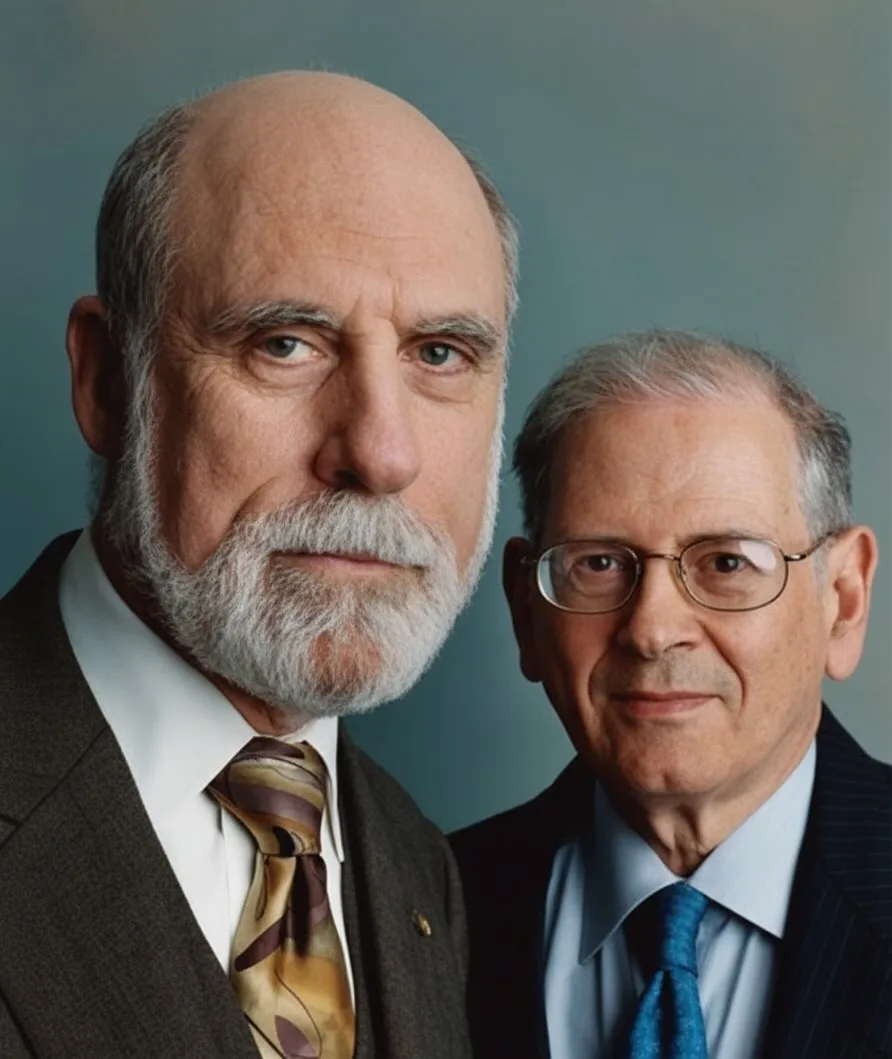
Vint Cerf & Bob Kahn
“Fathers of the Internet”
These two created TCP/IP, the communication protocols that allow different networks to interconnect—the actual technical foundation of the internet. Their work in the 1970s made it possible for computers worldwide to speak the same language. They’re often called the “Fathers of the Internet.”

Tim Berners-Lee
Inventor of the World Wide Web (1955-Present)
While working at CERN in 1989, Berners-Lee invented HTML, URLs, and HTTP—the building blocks of the World Wide Web. He made the web free and open to everyone, refusing to patent it. This selfless act democratized the internet and changed human civilization forever.

Ray Tomlinson
Email Inventor (1941-2016)
Created the first network email system in 1971 and chose the “@” symbol for email addresses—a decision that shaped digital communication forever. Email became the internet’s first “killer app,” proving that network technology could transform how people communicate.
“The internet is not a thing, a place, a single technology, or a mode of governance. It is an agreement.”
— John Heilemann, Tech Journalist
Busting Internet Myths
Myth: Al Gore Invented the Internet
This is one of the most persistent internet myths. Al Gore never claimed to have “invented” the internet. What he actually said in a 1999 interview was that he “took the initiative in creating the internet” as a Senator by sponsoring legislation that funded its development. Vint Cerf and Bob Kahn actually came to his defense, acknowledging his crucial role in promoting and funding internet development. So while he didn’t invent it, he did help make it possible through policy and funding.
Myth: The Internet and World Wide Web Are the Same Thing
This is a crucial distinction! The internet is the global network of connected computers—the infrastructure. The World Wide Web is just one service that runs on the internet, alongside email, file transfer, and other services. Think of the internet as the highway system and the web as the cars driving on it. You use the internet to access the web, but the internet existed for 20 years before the web was invented!
Myth: The Internet Was Created for Military Use Only
While ARPANET was funded by the military (Department of Defense), its primary purpose was actually to allow researchers at different universities to share computing resources and collaborate. The military was interested in redundant communication systems, but the internet was always intended for academic research. It just happened to be funded by defense budgets during the Cold War.
Internet History: Key Dates at a Glance
| Date | Event | Significance |
|---|---|---|
| 1957 | ARPA Founded | U.S. creates agency that will fund internet research |
| Oct 29, 1969 | First ARPANET Message | First data transmitted between two computers |
| 1971 | Email Invented | Ray Tomlinson creates first email system |
| 1973 | TCP/IP Development | Universal internet protocol begins development |
| Jan 1, 1983 | TCP/IP Adopted | “Official” internet birthday—all networks unified |
| 1989 | WWW Invented | Tim Berners-Lee creates the World Wide Web |
| 1991 | Web Goes Public | WWW becomes freely available to everyone |
| 1993 | Mosaic Browser | First graphical web browser makes internet accessible |
| 1998 | Google Founded | Search becomes central to internet experience |
| 2004-2007 | Web 2.0 Era | Facebook, YouTube, Twitter—social media revolution |
| 2025 | Today | 5.5+ billion internet users, AI integration, IoT explosion |
How the Internet Changed Everything
It’s hard to overstate just how profoundly the internet has transformed human civilization. In just over 50 years, it has:
Revolutionized Communication
From email to instant messaging to video calls, we can now communicate instantly with anyone, anywhere in the world. The internet has made distance irrelevant for human connection.
Democratized Knowledge
Access to information is no longer limited by geography or wealth. With Wikipedia, online courses, and digital libraries, human knowledge is available to billions for free.
Transformed Commerce
E-commerce has revolutionized how we buy and sell. Small businesses can reach global markets, and consumers have unprecedented choice and convenience.
Reshaped Entertainment
Streaming, social media, gaming, and digital content have changed how we consume and create entertainment. Anyone can be a creator and reach a global audience.
5.5+ Billion
People use the internet today—that’s over 67% of the world’s population connected!
Frequently Asked Questions
There are three key dates depending on your definition: October 29, 1969 (first ARPANET message), January 1, 1983 (TCP/IP adoption, often called the internet’s “official” birthday), or 1989 (World Wide Web invention). Most historians consider 1983 the true birth of the modern internet because that’s when the universal protocols were adopted that allow all networks to communicate.
No single person invented the internet—it was a collaborative effort spanning decades. Key contributors include J.C.R. Licklider (vision), Paul Baran (packet switching), Vint Cerf and Bob Kahn (TCP/IP protocols), and Tim Berners-Lee (World Wide Web). Each built upon the work of others, making the internet truly a collective human achievement.
The first message was supposed to be “LOGIN” sent from UCLA to Stanford on October 29, 1969. However, the system crashed after just two letters, so the historic first internet message was simply “LO.” About an hour later, they successfully transmitted the full word. Not exactly poetic, but history nonetheless!
The internet is the physical network infrastructure—the cables, servers, routers, and protocols that connect computers worldwide. The World Wide Web is a service that runs ON the internet, consisting of websites, web pages, and hyperlinks. Email, file transfer, and other services also use the internet but aren’t part of the web. The internet existed for 20 years before the web was invented.
ARPANET was funded by the U.S. Department of Defense to allow researchers at different universities to share expensive computing resources. While military resilience was a consideration (creating a network that could survive partial destruction), the primary goal was academic collaboration. The Cold War provided the funding, but scientific curiosity drove the innovation.
The growth is staggering. ARPANET started with 4 computers in 1969. By 1984, there were 1,000 hosts. The millionth host connected in 1992. Today, there are over 5.5 billion internet users (67% of world population), billions of websites, and over 21 billion IoT devices connected. The internet has grown from a small academic network to the backbone of modern civilization in just over 50 years.
Nobody owns the entire internet—it’s decentralized by design. Different organizations own different parts: companies own servers and cables, ISPs own network infrastructure, ICANN manages domain names, and various bodies develop standards. The internet is more like a shared agreement than a single owned entity. This decentralization is both its strength and what makes it so resilient.
Not entirely, and that’s by design. The internet was built to be resilient—data can route around damaged parts. However, governments can restrict access within their borders (like China’s Great Firewall), and major infrastructure damage could disrupt regional connectivity. A complete global shutdown would require simultaneously disabling millions of independent networks worldwide, which is practically impossible.
From “LO” to LOL: A 50+ Year Journey
The internet’s journey from a two-letter crash to a global network connecting billions is one of humanity’s greatest achievements. What started as a Cold War project has become the nervous system of modern civilization, transforming how we work, learn, play, and connect with each other.
The beauty of the internet’s history lies in its collaborative nature. No single genius created it alone—it was built by visionaries, engineers, scientists, and dreamers who each contributed a piece to the puzzle. From Licklider’s vision to Berners-Lee’s generous decision to make the web free for everyone, the internet represents the best of human collaboration and innovation.
As we look back on over five decades of internet history, it’s humbling to realize that we’re still in the early chapters of this story. With AI integration, quantum computing, and technologies we haven’t even imagined yet, the internet will continue to evolve in ways its creators never dreamed possible.
So the next time someone asks “when was the internet invented?”, you can tell them: it depends on what you mean by “internet,” but the journey began on October 29, 1969, with a crashed message and the simple word “LO.” From those humble two letters, we built the most transformative technology in human history. And we’re just getting started.